How a Two-Minute WHOIS Lookup Exposed a Fairly Clever Book Marketing Scam

WEST PALM BEACH, FL – Every week, businesses receive unsolicited emails promising publicity, recognition, awards, investment opportunities, or exclusive partnerships. Most are easy to ignore. Others are written well enough to make even experienced professionals pause for a closer look. Yesterday I received one of those emails.
The message had already been routed into my spam folder by Google’s filtering system. While legitimate emails can occasionally end up there, I generally treat anything in my spam folder with an extra level of skepticism. At the same time, I no longer assume that every message flagged as spam is malicious. Earlier this year, major email providers including Google, Yahoo, and Microsoft tightened their email authentication and spam filtering, making their filters far more aggressive. As a result, I now review my spam folder much more carefully because legitimate business inquiries occasionally end up there; some never make it to my inbox at all.
The message congratulated me on one of my latest books and claimed it had been identified as “a strong match for current market trends and reader interests.” According to the email, I was among more than 100,000 authors being reviewed for a special “New York Times Magazine Author Sponsorship Program,” with only 1,000 authors supposedly selected for a professionally written feature article, nationwide press release distribution, and expanded media exposure. The promotion normally cost $3,500, the email claimed, but selected authors would receive a 90 percent sponsorship discount, reducing the investment to just $350.
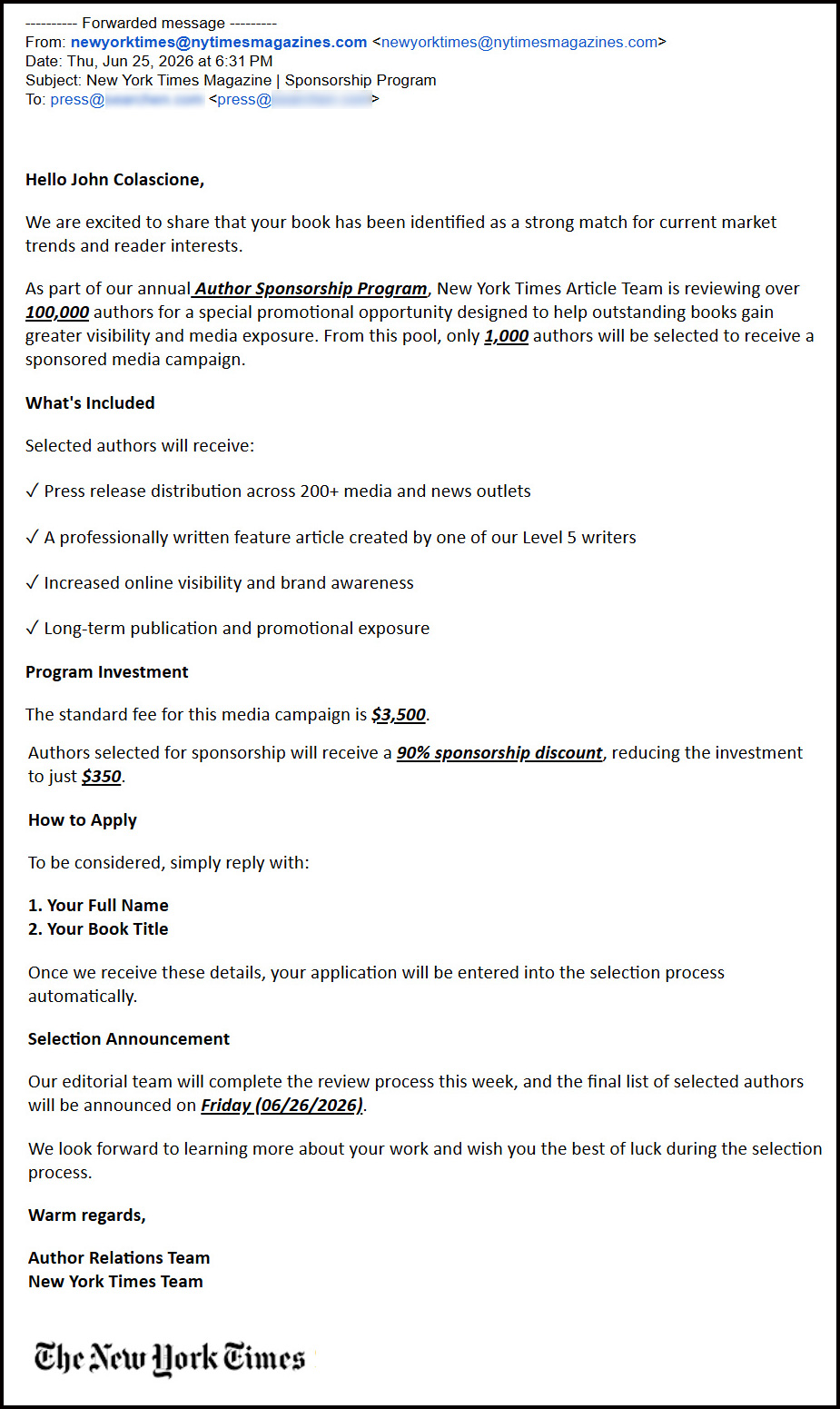
At first glance, the email looked well polished. The writing was professional, the formatting was clean, and unlike many phishing emails, there were no obvious spelling mistakes or grammatical errors. If it had arrived in my inbox, some recipients might have assumed it was legitimate.
But after noticing it had already been filtered as spam, I looked a little closer. One detail immediately stood out.
- The email wasn’t sent from @nytimes.com.
- Instead, it came from @nytimesmagazines.com.
That was enough reason to stop reading and start investigating.
A Two-Minute Investigation
One of the first things I often do when evaluating an unsolicited business offer is look up the domain registration. WHOIS records are public and frequently provide useful context about a website or email domain. While a recent registration doesn’t automatically indicate fraudulent activity, it can be an important piece of information when evaluating an unexpected solicitation from someone claiming to represent a globally recognized organization.
In this case, the results were difficult to ignore.
According to the public WHOIS database, nytimesmagazines.com was registered on June 23, 2026. The email I received was sent on June 25 – only about two days later. For a domain presenting itself as part of one of the world’s most recognizable news organizations, that immediately raised questions. Well-established media companies generally conduct official correspondence through long-established corporate domains, not newly registered look-alike domains that appear almost overnight.
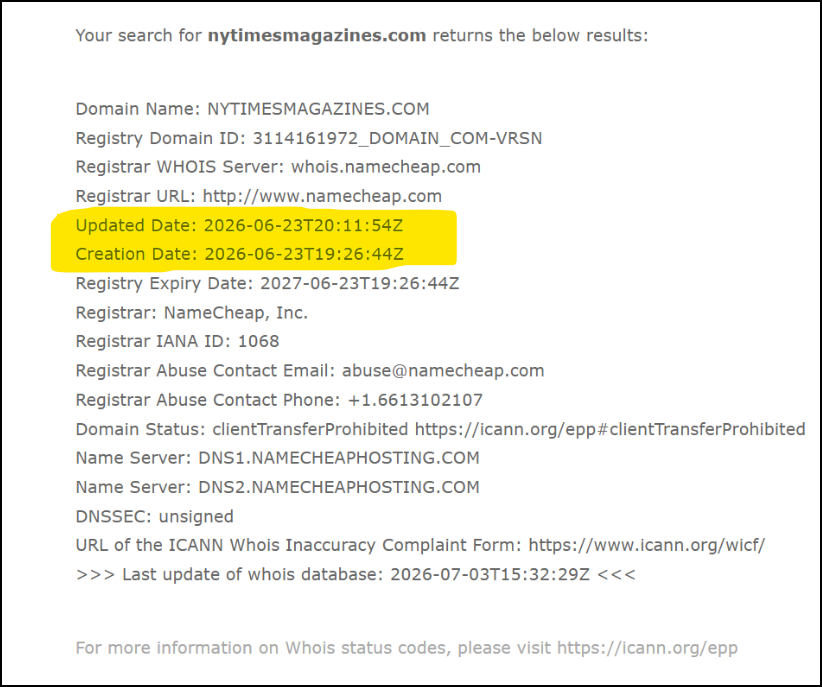
A newly registered domain alone does not prove wrongdoing. New domains are registered every day for entirely legitimate reasons. However, when combined with an unsolicited promotional offer requesting payment, it becomes another reason to investigate before responding.
How I Verified the Email
Before responding, I performed three quick checks:
- Looked at the sender’s email address – not just the display name.
- Checked the domain registration using a public WHOIS lookup.
- Compared the domain’s registration date with the date I received the email.
That was enough. Based on those findings, I concluded the offer wasn’t worth pursuing and moved on.
Why These Emails Work
Messages like this are carefully designed to appeal to something many authors naturally hope to receive: recognition.The email begins with praise, telling recipients their work has been identified as matching current reader interests. It then creates exclusivity by claiming only a small percentage of authors will be selected from a much larger pool. Finally, it introduces a substantial discount, making the requested payment appear insignificant compared to the perceived value of the opportunity.
From a marketing perspective, it’s a familiar formula. Build credibility, create scarcity, establish urgency, then present a limited-time offer that feels too good to ignore. Artificial intelligence has made these campaigns even more convincing. Gone are the days when suspicious emails were filled with broken English and obvious mistakes. Today’s messages often read like professionally written marketing copy, making it increasingly difficult for recipients to distinguish legitimate outreach from deceptive solicitations.
Publishing Scam Snapshot
| Book Marketing & Publishing Scam Facts | Reference |
|---|---|
| The Authors Guild maintains an active list of publishing scam alerts, including fraudulent book marketing, publishing, and impersonation schemes targeting authors. | Authors Guild – Publishing Scam Alerts |
| Writer Beware has spent more than two decades documenting questionable publishers, literary agencies, book marketers, and promotional services targeting authors. | Writer Beware – About |
| Book marketing scams commonly begin with unsolicited praise about an author’s work before introducing paid promotional services or media exposure. | Writer Beware – The Book Marketing Scam That Went the Extra Mile |
| Scammers increasingly impersonate major publishers, literary agents, editors, and other recognizable publishing brands to gain an author’s trust. | Writer Beware – Publishing Scams Archive |
| The Authors Guild has recently warned of a noticeable increase in email scams specifically targeting authors. | Authors Guild – Rise in Email Scams Targeting Authors |
Verification Is Easier Than Ever
The encouraging part is that verifying unsolicited offers has also become easier. A WHOIS search takes less than a minute. Looking at when a domain was registered, whether it matches the organization being represented, and whether the sender’s email address corresponds with the company’s official website can quickly reveal inconsistencies that deserve additional investigation.
Businesses should also avoid clicking links contained within unsolicited emails. Instead, visit the organization’s official website directly, locate its published contact information, and independently confirm whether the promotion actually exists. That simple habit can prevent far more costly mistakes than any spam filter ever will.
The Lesson
Whether this particular email campaign ultimately proves to be fraudulent is almost beside the point. The more important lesson is that business owners, authors, and professionals should never assume an email is legitimate simply because it looks professional or references a recognizable brand. Now more than ever, trust needs to be earned through verification – not appearance.
In my case, the entire investigation took less than two minutes. A quick WHOIS search revealed enough information for me to disregard the email before investing any additional time. As artificial intelligence continues making scams more polished and persuasive, simple investigative habits, such as verifying domain registrations, confirming official websites, and independently contacting organizations, may become some of the most valuable cybersecurity skills a business owner can develop.
Related Scam Alerts
Scams continue to evolve alongside technology. Here are more articles covering online fraud, phishing, impersonation, domain name abuse, and deceptive marketing practices.
- Phishing Has Evolved – The Scam Isn’t the Fake Email, It’s the Real Phone Call
- Verification Code Scams: Never Share an OTP You Didn’t Initiate or Request
- Near Identical Domain Used To Scam Over $800,000 With Wire For Real Estate Deal
- Fake TD Bank Website Email Scam Steals Username, Password, Text-Message Code
- Amazingly Convincing Facebook Phishing Scam Takes Place on Facebook.com Itself
- This AMEX Email Phishing Scam Wants You Homeless & Poor, With A Zero FICO Score
- Just Some Fun With an Online Classifieds Scammer from Craigslist, That’s All
- Verizon Wireless Phishing Email: Scams & How to Avoid Them (Part 2)
- Fake Verizon Wireless Email: Email Scams & How To Avoid Them

About The Author: John Colascione is Chief Executive Officer of SEARCHEN NETWORKS®. He specializes in Website Monetization, is a Google AdWords Certified Professional, authored a how-to book called ”Mastering Your Website‘, and is a key player in several online businesses.
Add STRATEGIC REVENUE as a Google Preferred Source to see more of our business, technology, and digital strategy coverage in Google Search.
Add Strategic RevenueYou can now select the categories you're interested in and receive email updates when new articles are published in only those categories.