
Why the Domain “Ask.com” Is Likely More Valuable Today Than Ever Before
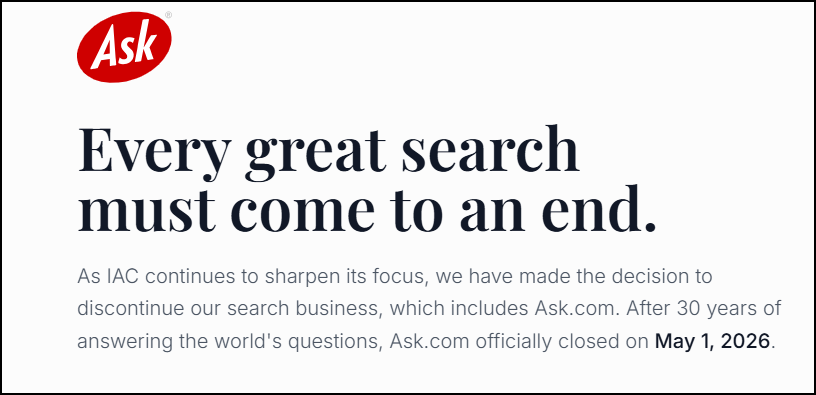
WEST PALM BEACH, FL – For much of the internet’s early history, Ask.com was a prominent search engine that just failed to keep pace with the rise of Google. But in one of the more ironic twists of the AI era, the domain name may suddenly be more relevant than it has been in decades.
According to a newly circulated update from ATM Holdings, the company is now overseeing the sale of Ask.com following the retirement of the Ask search engine by parent company IAC on May 1. And the timing could not be more symbolic. For the last 25 years, internet users were trained to “search.” Today, artificial intelligence is retraining users to “ask.”
That subtle shift in behavior may represent one of the biggest changes in the history of the web.
The Internet Is Moving From Search Boxes to Conversations
Traditional search engines required users to type keywords, scan lists of blue links, open multiple websites, compare information, and piece together answers manually.
AI changes that dynamic entirely.
Instead of searching, users are increasingly interacting with conversational systems:
- Ask ChatGPT
- Ask Claude
- Ask Gemini
- Ask Perplexity
The interface itself has changed from navigation to interaction. That makes the word “ask” remarkably powerful again. In many ways, Ask.com may have been built for the internet people are only now beginning to use.
The original concept behind Ask Jeeves – allowing users to ask questions naturally instead of relying on rigid keyword searches – may have simply arrived years before the technology was capable of fully delivering on the promise.
Now, AI finally can.
“Why Search When You Can Find?”
A slogan I once used for an automotive business came back to mind while thinking about the evolving relationship between search and AI. The phrase reflects the simplicity and contrast between effort and outcome – that increasingly separates traditional searching from simply asking for answers.
One of the most compelling aspects of the Ask.com story is how closely the domain aligns with the emerging philosophy behind generative AI. Search implies effort. Asking implies resolution.
Traditional search behavior often meant:
- researching
- filtering
- browsing
- comparing
- navigating
AI behavior increasingly means:
- receiving direct answers
- summarization
- synthesis
- completion
- decision support
That distinction matters. The modern internet user is no longer simply looking for information. Increasingly, they are looking for outcomes. In that environment, Ask.com transforms from a nostalgic search engine brand into something far more valuable: a universal action word tied directly to how humans naturally interact with AI.
A Premium Domain at the Center of the AI Gold Rush
The domain’s sale will also attract attention because of who is handling the transaction. ATM Holdings announced that it has partnered with veteran domain broker Larry Fischer to oversee the sale.
Fischer recently gained industry-wide attention for his involvement in the reported sale of AI.com, one of the most talked-about domain transactions of the modern AI era. Combined with ATM Holdings’ involvement in transactions including Chat.com, Rocket.com, and Home.com, the sale of Ask.com immediately becomes more than a simple domain listing.
It becomes a signal. The premium domain market is rapidly reorganizing around AI, conversational interfaces, and category-defining digital brands.
According to the ATM Holdings briefing, the current wave of domain acquisitions differs from previous speculative surges because it is tied directly to the long-term emergence of artificial intelligence and massive capital flowing into AI startups and infrastructure.
That context matters because domains like Ask.com are no longer being evaluated solely as websites. They are increasingly being viewed as strategic identity assets for the next generation of AI platforms.
The Return of Exact-Match Authority
For years, many exact-match domains lost some of their perceived value as social media platforms, apps, and search engines became dominant traffic gateways. But AI may be reversing part of that trend.
As consumers become overwhelmed by misinformation, SEO spam, and AI-generated clutter, trust and memorability are becoming more important again.
Ask.com possesses several characteristics that are almost impossible to replicate:
- A single common English dictionary word
- Instant global recognition
- Natural conversational meaning
- Action-oriented branding
- Extreme memorability
- Direct alignment with AI interaction patterns
In branding terms, it checks every box. And unlike newly invented AI brand names, “Ask” requires no explanation.
Could Ask.com Become an AI Company?
That question is no longer far-fetched. In fact, Ask.com may now be more valuable as an AI platform brand than it ever was as a traditional search engine.
The domain sits at the intersection of:
- AI assistants
- answer engines
- conversational search
- enterprise copilots
- consumer AI interfaces
- knowledge retrieval systems
Virtually every major AI platform today revolves around the same human behavior: ask questions. That makes Ask.com one of the rare legacy internet assets whose meaning has actually strengthened in the AI era rather than faded.
In a strange and unexpected way, Ask Jeeves may have simply arrived 25 years too early.

About The Author: John Colascione is Chief Executive Officer of SEARCHEN NETWORKS®. He specializes in Website Monetization, is a Google AdWords Certified Professional, authored a how-to book called ”Mastering Your Website‘, and is a key player in several online businesses.
Add STRATEGIC REVENUE as a Google Preferred Source to see more of our business, technology, and digital strategy coverage in Google Search.
Add Strategic RevenueYou can now select the categories you're interested in and receive email updates when new articles are published in only those categories.


Interesting, I’m writing an AI search tool for domainnamesoup.com to use AI to find available domain names. Should be ready soon.
Also you can search for .ai domains to see if they’re available to buy.