
 *** Here Is A List Of Some Of The Best Domain Name Resources Available ***
PALM BEACH, FL – The latest Global Domain Report, published by InterNetX in collaboration with Sedo, is over 100 pages long and packed with charts, data, and industry commentary. It is one of the most thorough domain industry reports I have read in years – if not ever. But most people are not going to sit down and read the entire thing. They’ll skim through it. So here is the nitty-gritty. The real takeaways. What this report is actually telling us about where the domain industry is headed – and more importantly, what it means.
1. The market is healthy, but mature.
This is not a boom-era report. The numbers point to a large, steady, commercially mature industry. The report puts global registrations at 386.9 million, with 2.2% YoY growth, 3.4% ccTLD growth, and especially strong 29.9% growth in new gTLDs. That tells me the domain business is no longer about explosive universal growth – it is about share shifts, specialization, and strategic positioning. Pages 9 through 12 make that very clear.
2. .com is still king, but it is no longer the whole story.
The report does not say .com is fading. Quite the opposite. It remains dominant in registrations, developed websites, redirects, and top-end aftermarket sales. But it also shows that the market around .com is widening. New gTLDs now represent 12.4% of the market, and ccTLDs remain a major force. That is a meaningful shift. The industry is becoming more layered: .com for universal authority, ccTLDs for local trust, and selected new gTLDs for branding and niche fit. Pages 11, 12, 16, and later the Sedo sections support that.
3. AI is increasing domain creation, but the bigger story is that AI is changing what domains are for.
A quote by Eshan Pancholi – Vice President, Marketing at ShortDot, stuck out to me and captures one side of it – AI lowers the barrier to building websites, turning more ideas into live projects. The report agrees with that in several places. But the deeper insight comes later: domains are becoming “verified trust anchors” for AI systems.
That is the strongest idea in the whole report in my opinion.
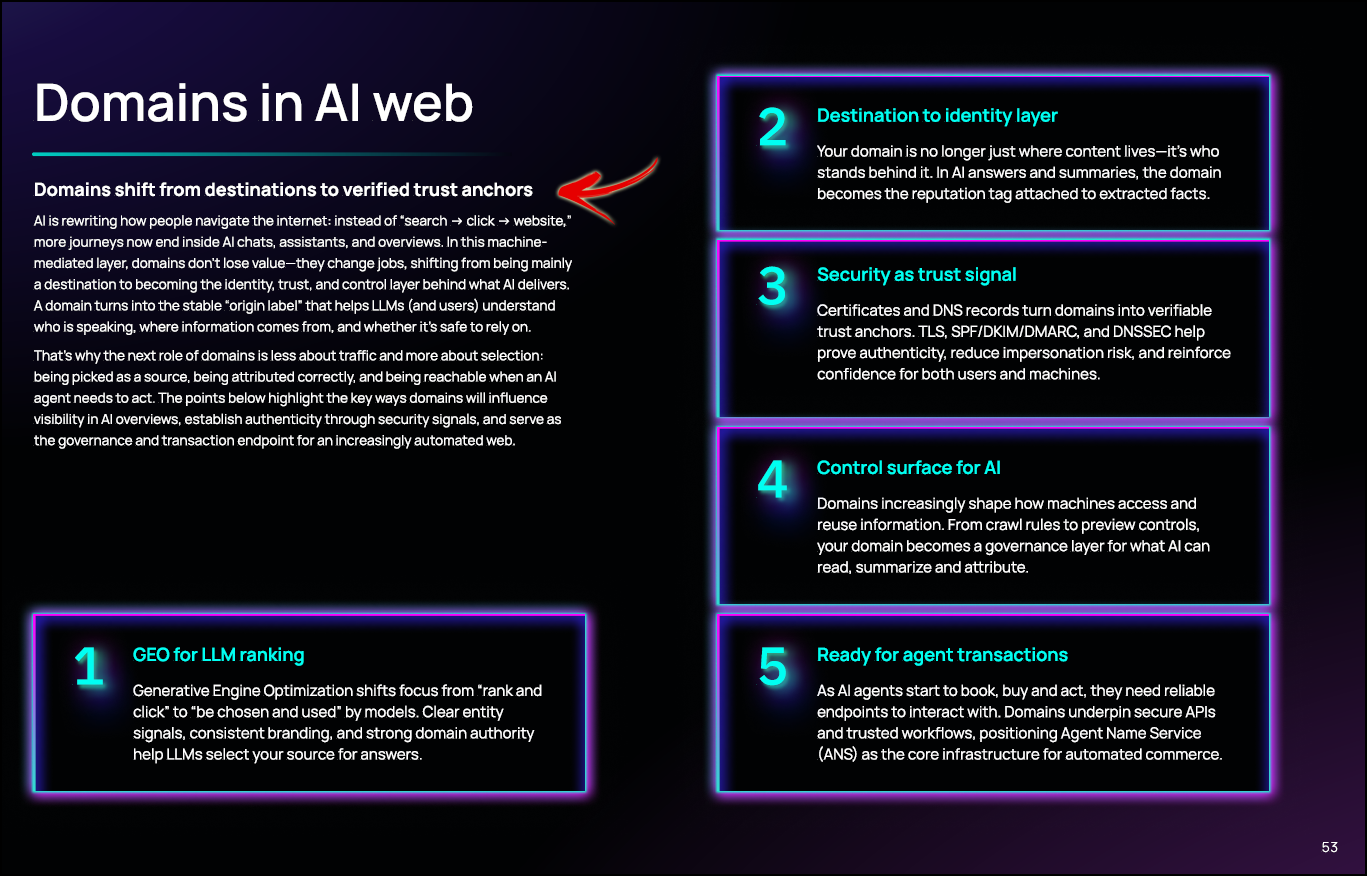
On page 53, the report says domains are moving from destinations to identity and control layers – helping AI systems understand who is speaking, whether a source is authentic, and whether it is safe to act on. That is a very important shift. It means the future value of a domain may come less from type-in traffic and more from machine trust, attribution, agent access, and authority signals. Page 62 brings everything together. The conclusion is simple: value will increasingly concentrate in high-authority, secure namespaces.
This is not just a takeaway from the report – it is something I believe, and something I am already seeing play out in the market.
4. Page 53 may be the most important page in the report.
That page is basically the blueprint for the next phase of domains. It lays out five ideas:
- GEO for LLM ranking,
- domains as identity layers,
- security as a trust signal,
- domains as a control surface for AI,
- and readiness for agent transactions.
That is far more forward-looking than the usual “domains are digital real estate” framing. The report is really saying that a domain may become the canonical trust label behind content, APIs, automation, and machine-mediated commerce. For people in branding, SEO, publishing, or domain investing, that is a much bigger thesis than registration counts alone.
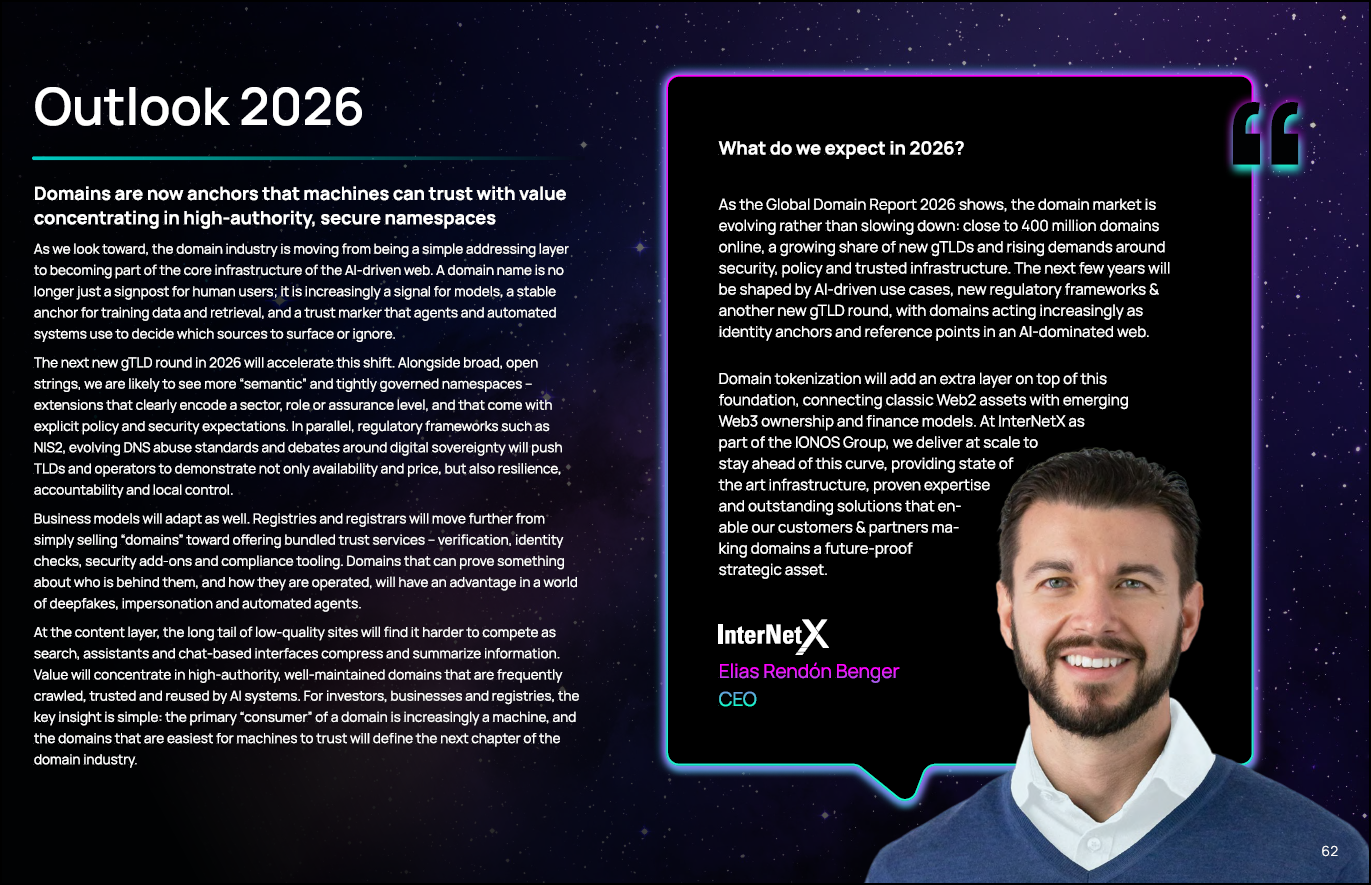
5. Page 62 is the strategic summary of the whole report.
Page 62, featuring insights from Elias Rendón Benger, CEO of InterNetX, says value will increasingly concentrate in high-authority, secure namespaces. I think that is probably right. As AI systems summarize the web and reduce direct browsing, weak low-trust sites get filtered from visibility. Strong domains with authority, security signals, verified provenance, and consistent usage become more valuable. So in plain English: the report is arguing that the future will reward domains that machines trust, not just humans remember.
That may be the single best one-sentence takeaway from the report.
6. Security and compliance are no longer optional extras.
The report repeatedly returns to DNSSEC, DMARC, SPF, HTTPS, NIS2, abuse mitigation, and identity checks. That is not filler. It is telling registries, registrars, and serious operators that security is now a product feature and a market requirement. In Europe especially, compliance is becoming what the report calls the new “cost of entry.” That means smaller, less sophisticated operators may get squeezed-out, and bigger players with automation and compliance tooling may gain more ground. Pages 23, 34, 43 through 47, and 65 all support that.
7. New gTLDs have clearly crossed from experiment to structural relevance.
This report is more bullish on new gTLDs than many traditional domainers will like, but it is not blindly bullish. It admits the problems: lower awareness, higher renewal costs, weaker resale confidence, uneven active use, and security lag in some areas. Still, it shows they are no longer marginal. They have taken roughly a decade to mature, and now the report presents them as a real “secondary layer” in the domain market. That feels accurate to me. The winners are not all new gTLDs – just a narrower set with scale, semantic clarity, or strong vertical use cases. Pages 24 through 42 make that case.
8. The 2026 gTLD round matters, but not because every new extension will be a winner.
The report is clear that the next round is important strategically, but it also hints that success will be harder this time. The easy strings are gone, visibility is expensive, compliance is heavier, and go-to-market execution matters more. So the next round is not just a land grab. It is a bet on whether an operator can create trust, relevance, distribution, and durable economics. That is a more sober and realistic view than a lot of gTLD hype.
9. The aftermarket remains strong, but quality matters more than ever.
Sedo’s data shows strong liquidity, more Buy Now behavior, broader TLD diversity, and continued strength in .com, ccTLDs, and selected alternatives. But the report also says clearly that buyers are becoming more selective. Mid-market activity drives the market, not just headline sales. Quality, clarity, brevity, and usability matter. This fits with the broader theme that real commercial use cases are taking priority over loose speculation. Pages 80 through 99 say this very plainly.
10. .ai is not just hype anymore.
The report treats .ai as having crossed into practical commercial adoption. It hit the 1,000,000 registration milestone in January 2026 and showed strong aftermarket sales. More importantly, the report frames .ai as moving from trend status into functional business naming. That seems right. Whether it stays overheated is another question, but the report’s position is that .ai is now a durable category, not just a speculative wave.
11. ccTLDs may actually be stronger than many people appreciate.
One underappreciated point in the report is how resilient and embedded ccTLDs remain, especially in Europe. Strong local trust, better pricing in many markets, high retention, and business familiarity all keep them highly relevant. If AI shifts discovery away from raw URL visibility and toward trust and authority, local stronghold extensions could remain very defensible assets. That part of the report felt especially grounded.
12. The report is ultimately bullish on domains – but only the right kind of domains.
It is not saying all domains rise equally. It is saying the market is becoming more selective. The winners look like this:
- strong .coms,
- trusted ccTLDs,
- meaningful and scalable new gTLDs,
- secure and well-operated names,
- domains tied to real businesses, products, AI systems, or authority.
The losers are likely to be low-quality, weakly maintained, speculative inventory with little trust, little usage, and little machine relevance.That is the real subtext of the whole report.
My shortest summary of the report would be this:
Domains are evolving from addresses into trust infrastructure. AI is accelerating domain creation, but it is also making authority, verification, and attribution far more important. The industry is not becoming less valuable – it is becoming more selective, more technical, and more strategic. Page 53 explains the mechanism, and page 62 explains the consequence.
While the above are the main take aways I found most interesting from the free report, there is a lot more detail throughout, and I still recommend downloading and reviewing it in full: https://hub.internetx.com/en/en/global-domain-report-2026

About The Author: John Colascione is Chief Executive Officer of SEARCHEN NETWORKS®. He specializes in Website Monetization, is a Google AdWords Certified Professional, authored a how-to book called ”Mastering Your Website‘, and is a key player in several online businesses.
John – As usual, you continue to provide the most valuable insights in the entire realm of domain industry bloggers.
And IMO, the most important thing you summarized for domain investors is:
“The winners look like this: …domains tied to real businesses, products, AI systems, or authority.”
Superb job!
Thank you for reading, Gene. the game is changing, As it always has, but now faster And more significantly, than ever.