
Google Updates Its Terms of Service: Here’s What Changed in Plain-English
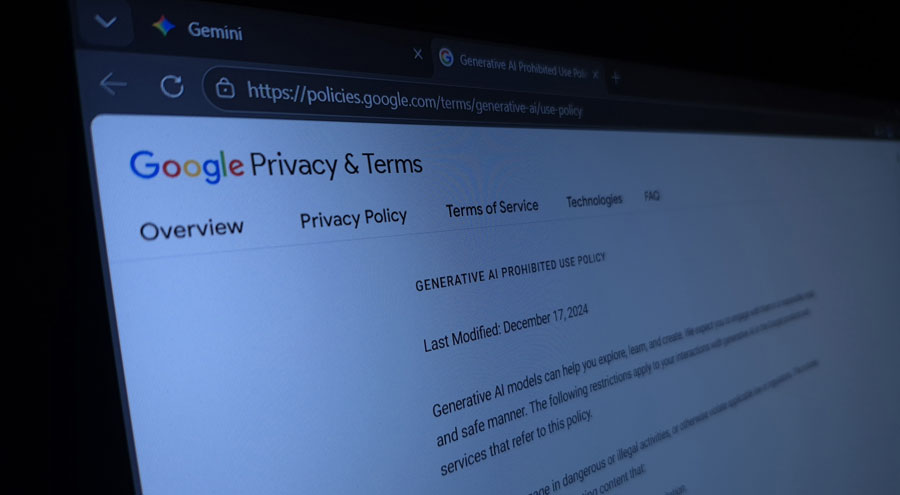
WEST PALM BEACH, FL – Google has announced that its updated Terms of Service will take effect on July 30, 2026, and while the company says the changes won’t affect the way most people use its products, the revised agreement does include several important clarifications that are worth understanding. Like many online terms of service, the document spans dozens of pages of legal language that few users ever read from beginning to end.
If you don’t have time to sift through all of the legal jargon, I’ve done it for you. Below is a plain-English breakdown of the most notable changes, including new language about background internet usage, expanded provisions related to artificial intelligence, updated rules regarding automated access and scraping, and several legal clarifications. While this isn’t an exhaustive review of every edit, it highlights the changes most likely to matter to everyday users, website owners, and businesses that rely on Google’s services.
The updated Terms of Service can be found at: https://policies.google.com/u/1/terms/update
For the average Google user, this is a fairly routine legal update. Google isn’t announcing a major change to how its services work or to its privacy practices. Instead, it’s reorganizing and clarifying several sections of the agreement while adding language to address newer technologies such as AI.
Here are the items that stood out:
1. New section about background internet usage
This is probably the biggest addition.Google now explicitly states that its services may access the internet even when you are not actively using them. Examples include:
- Software updates
- Security updates
- Improving services
- Synchronization
- Advertising-related operations
They also remind users that this activity may count against mobile or internet data plans and that users are responsible for those costs.This doesn’t necessarily represent new behavior – Android devices and Google apps have long done background syncing – but Google is making it much more explicit.
2. More AI-specific language
Several new provisions specifically address generative AI.
Examples include prohibiting users from:
- Using Google’s AI-generated content to train competing AI models.
- Reverse engineering Google’s machine learning models.
- Using prompt injection or adversarial prompting outside approved security testing.
- Misrepresenting AI-generated content as human-created in deceptive situations.
This reflects how quickly AI has become part of Google’s products.
3. Stronger language against scraping
Google now specifically prohibits:
- Violating robots.txt instructions
- Scraping content where machine-readable instructions prohibit it
- Using automated systems in ways that violate those restrictions
They’ve always discouraged abusive scraping, but now they’re spelling it out much more clearly.
4. Your content still belongs to you
This hasn’t changed much. Google again says:
- You retain ownership of your content.
- You grant Google a worldwide, royalty-free license to host, display, modify, and process that content for operating and improving its services.
- That license generally ends once the content is removed, subject to certain exceptions (such as copies already shared with others).
This is standard language that has existed for years.
5. Account suspension language
The suspension section is mostly unchanged but includes modern examples like:
- Phishing
- Hacking
- Harassment
- Scraping content
- Misleading users
Google emphasizes it will generally provide notice when reasonably possible before taking action.
6. California law remains
Disputes continue to be governed under California law and generally heard in Santa Clara County, California.
From a business owner’s perspective
The AI provisions are probably the most interesting part. Google is now expressly saying users may not:
- use Google-generated AI output to build competing AI systems,
- circumvent technical restrictions on AI systems,
- ignore machine-readable crawling restrictions such as robots.txt where those restrictions prohibit activities like crawling or training.
These additions are consistent with a broader industry trend of AI companies trying to protect their models and content from unauthorized reuse.
Should you be concerned?
For ordinary Google product users, Probably Not
The email accurately summarizes the update. Most of the changes:
- clarify existing practices,
- modernize the terms for AI,
- explain background network usage,
- reorganize legal language rather than fundamentally changing your rights.
For someone using Gmail, Search, Maps, Drive, YouTube, or Android normally, nothing significant about day-to-day use appears to change. The only section that feels genuinely “new” is Google’s explicit explanation that its services may use internet connectivity in the background for updates, security, synchronization, service improvements, and advertising-related operations, and that any resulting data charges are the user’s responsibility.
Disclaimer: This article is intended as a plain-English summary of Google’s updated Terms of Service and is provided for informational purposes only. It is not legal advice and should not be relied upon as a substitute for the official Google Terms of Service or advice from a qualified attorney. While we have made every effort to accurately summarize the changes, readers should review the official Terms of Service if they need to understand the complete legal agreement or how it applies to their specific circumstances.

About The Author: John Colascione is Chief Executive Officer of SEARCHEN NETWORKS®. He specializes in Website Monetization, is a Google AdWords Certified Professional, authored a how-to book called ”Mastering Your Website‘, and is a key player in several online businesses.
Add STRATEGIC REVENUE as a Google Preferred Source to see more of our business, technology, and digital strategy coverage in Google Search.
Add Strategic RevenueYou can now select the categories you're interested in and receive email updates when new articles are published in only those categories.


Can anyone tell me what is considered my “content”, that is mentioned in #4 above, that I’m licensing Google to use?
Thanks!
Your content can include documents or writing of almost any kind. Submitting information, images, posting photos, uploading documents, media files, video files, audio files, or even speaking into an AI assistant are all actions that you take to ‘provide content’ to Google. The Terms of Service also remind users that Google’s Privacy Policy applies to their use of the services. The Privacy Policy explains what information Google collects, such as searches you perform, pages you visit, device information, interactions with Google’s products, and other usage information. In other words, the content you provide and the information Google collects about your use of its services are likely bundled together in some way. Thank you for reading.