Domains, Not Hype: Insights from Andrew Rosener’s Conversation on Miss Understood

WEST PALM BEACH, FL – This week I took some time to watch an episode of Miss Understood hosted by Rachel Uchitel featuring Andrew Rosener, founder and CEO of MediaOptions, one of the best-known domain brokerages in the world. While I’ve been in this business for a long time, I thought the conversation offered a lot of good perspective — especially for people who may be newer to the industry or still wrapping their heads around digital asset value.
The episode was titled “The Godfather of Domains: How Andrew Rosener Built an $800M Digital Real Estate Empire.” To clarify, Rosener didn’t claim an $800 million empire; what he actually said was that his company has brokered roughly $800 million in cumulative domain sales over the last fifteen years – about $100 million annually in recent years. Quite an achievement.
Seeing Domains as Real Investments
Rosener framed domain names as digital real estate – a finite resource that underpins nearly every modern business. Through what he calls the Rosener Equation, he explained that a great domain can directly lower customer acquisition costs by attracting more organic traffic, building trust, and converting visitors more efficiently. In other words, price and value aren’t the same thing; a domain’s true worth lies in its measurable business impact over time.
He also compared domains to other “scarce” assets such as gold and Bitcoin, saying that scarcity is the key investment driver in the decade ahead. Real estate may face downward pressure from rising insurance and tax costs, but domains require no maintenance and can appreciate as more of the world shifts online.
Why .COM Still Dominates
Despite the rise of new extensions and alternate TLDs, Rosener made it clear that .com remains king – and not just for recognition or branding. The biggest reason is email deliverability. Many alternative extensions have been heavily used for spam, which can lead to filtering or blocked messages. If your customers or partners aren’t receiving your emails, the conversation ends before it starts.
Rosener’s advice: when possible, secure the .com version of your brand. If it’s unavailable, use a prefix or suffix like “get” or “app” rather than jumping to a lesser-known extension. That way, you can easily “drop the training wheels” later by upgrading to the exact match .com.
Another important point that often goes unnoticed is how many core systems were originally designed to recognize only the classic domain extensions — .com, .net, and .org. When those systems were first built, no one anticipated the explosion of hundreds of new TLDs like .club, .info, or .xyz. As a result, software written years ago sometimes fails to properly handle these newer extensions.
That can lead to subtle but frustrating glitches. Some web forms reject valid email addresses simply because they end with an unfamiliar TLD. Others fail to auto-link URLs or validate them correctly. These issues aren’t hard to fix, but the code that handles them is often buried deep in legacy infrastructure. Many companies simply delay the updates, choosing to “kick the can down the road.”
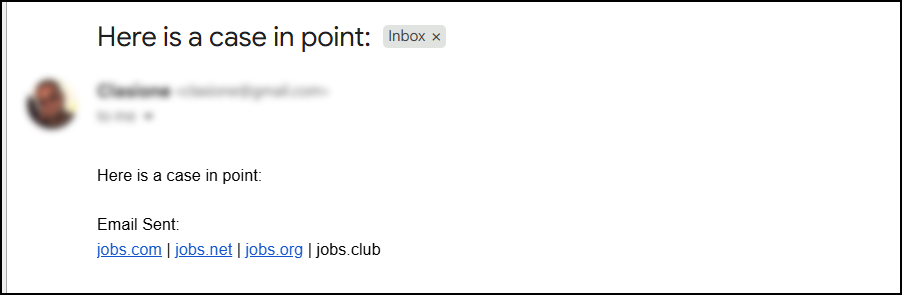
A simple demonstration makes the point clear: send yourself an email containing the domains jobs.com, jobs.net, jobs.org, and jobs.club. When the message arrives, you’ll notice that the first three are automatically hyperlinked – but jobs.club isn’t. That’s not user error; it’s a sign that even major platforms like Gmail still treat alternative extensions as outsiders in a .com-centric world. Google just wasn’t sure whether it was meant to be a URL or simply the end of a sentence without proper spacing.
Evergreen Over Trends
Rosener also touched on the difference between evergreen domains and trend chasing. Successful investors, he said, buy names that were valuable yesterday, are valuable today, and will still be valuable tomorrow. While others chase the latest buzzword – from “metaverse” to “AI” to “crypto” – the steady money is in generic and descriptive words that people consistently search for. These names have enduring mindshare and intrinsic commercial appeal.
From Fish to Digital Fortune
One of the most interesting parts of the interview was Rosener’s story of how he transitioned from selling seafood to selling domains. A simple domain trade for a rare ham – literally swapping domain names for a cured leg of meat – became his “lightbulb moment.” That realization set him on a path from cold calls in the scallop business to brokering some of the largest digital property deals in history, including Zoom.com and X.com.
It’s a story about recognizing value where others see noise, and understanding that every company, large or small, eventually needs its name online.
The Road Ahead: 2026 and Beyond
Rosener also discussed the next ICANN gTLD round, expected in 2026, when new domain extensions will once again be open for application. While that will bring another wave of experimentation, he believes the core market – the left of the dot – will remain stable. In other words, whatever happens with .bit, .ai, or .xyz, the real opportunity still lies in owning or brokering strong .coms and premium single-word domains that will never be duplicated.
For seasoned investors, much of what Rosener said will sound familiar. But for newcomers, it’s a crash course in how digital property mirrors, and in some ways surpasses, traditional real estate. Domain names are finite, functional, and foundational. They build trust, reduce acquisition costs, and can outlast nearly any marketing trend.
If you haven’t seen it yet, it’s worth watching the full episode below.
Watch the interview:
The Godfather of Domains: How Andrew Rosener Built an $800M Digital Real Estate Empire

About The Author: John Colascione is Chief Executive Officer of SEARCHEN NETWORKS®. He specializes in Website Monetization, is a Google AdWords Certified Professional, authored a how-to book called ”Mastering Your Website‘, and is a key player in several online businesses.
Add STRATEGIC REVENUE as a Google Preferred Source to see more of our business, technology, and digital strategy coverage in Google Search.
Add Strategic RevenueYou can now select the categories you're interested in and receive email updates when new articles are published in only those categories.