Google Ads ‘Loosens’ Business Name Rules in Unusual Policy Update
MOUNTAIN VIEW, CA – Google Ads is relaxing its business name requirements, giving verified advertisers more flexibility when their recognized brand name does not match the domain used in an advertisement. Google Ads policy changes usually mean more restrictions, more verification or another layer of compliance. This month, Google is doing something considerably less common: loosening a rule.
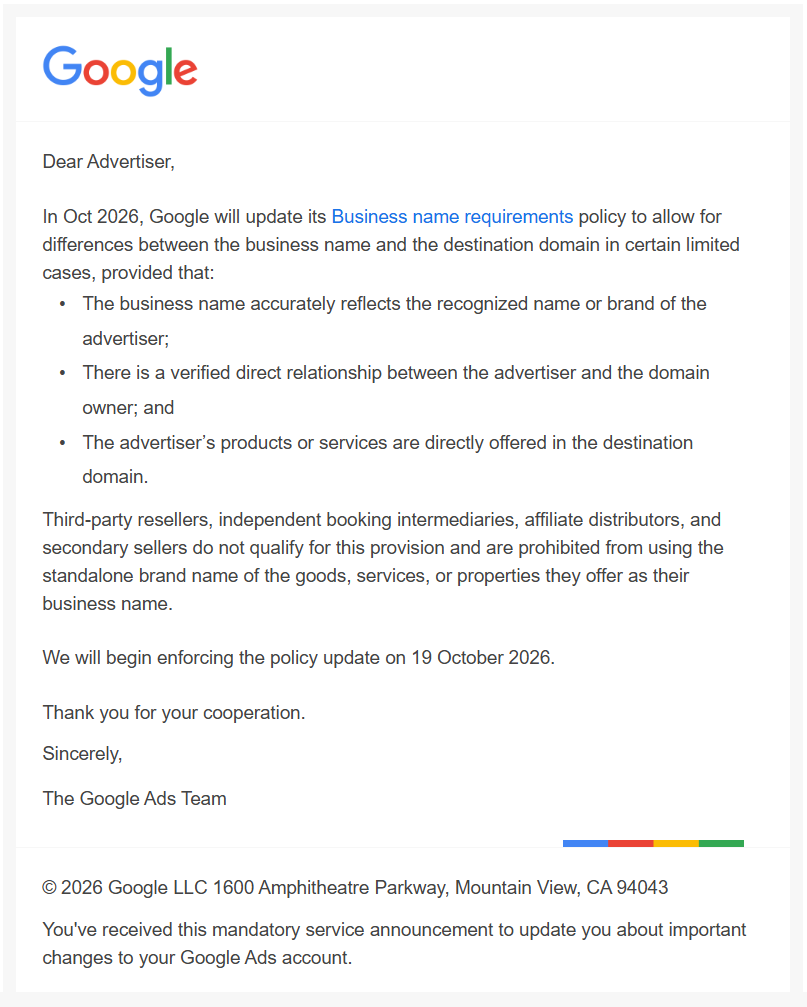
Beginning October 19, 2026, Google will allow differences between an advertiser’s business name and destination domain in certain circumstances. Under the updated policy, the business name must accurately represent the advertiser’s recognized name or brand, there must be a verified direct relationship between the advertiser and domain owner, and the advertiser’s products or services must actually be offered on the destination website.
The change addresses a legitimate problem for companies operating multiple websites. For example, a company called Acme Marketing Inc. might own AcmeMarketing.com, InternetAdvertisingServices.com and LocalBusinessMarketing.com. The company behind all three websites is still Acme Marketing, even though two of the domains don’t contain the company’s name.
Google’s previous approach could make that distinction difficult because business names used in ads were generally expected to closely correspond with the advertiser’s verified identity or destination domain. The new policy allows Google to focus more on who actually controls the website rather than whether the business name and domain contain matching words.
Google is not, however, opening the door for affiliates and resellers to impersonate brands. Third-party resellers, independent booking intermediaries, affiliate distributors and secondary sellers are specifically excluded from the exception. A website selling Nike products, for example, cannot simply identify itself as “Nike” unless it actually represents that business.
That distinction may be the most important part of the change. Google isn’t abandoning advertiser verification. Instead, it appears to be saying that once it can establish the identity of an advertiser and verify its relationship with a domain, an exact name-to-domain match isn’t always necessary. That is a considerably more practical approach for modern businesses.
Companies routinely operate multiple websites, acquire descriptive domains, launch product-specific properties and maintain brands that bear little resemblance to their corporate names. A business called Smith Holdings LLC might legitimately own and operate FloridaRoofing.com. The fact that those names don’t match doesn’t make the advertiser deceptive.
For businesses using descriptive or premium domain names, the change could be particularly useful. An established company may be able to advertise using the credibility of its recognized brand while directing customers to a specialized domain it legitimately operates.
There are still unanswered questions, particularly about how Google will establish a “verified direct relationship” between advertisers and domain owners in less obvious ownership structures. But the direction of the policy change itself is welcome.
Google Ads has spent years adding verification procedures, restrictions and increasingly detailed advertising requirements. This time, Google looked at a rigid requirement and apparently concluded that legitimate businesses needed more flexibility. For once, a Google Ads policy update actually makes a rule less restrictive rather than more complicated. Unprecedented.

About The Author: John Colascione is Chief Executive Officer of SEARCHEN NETWORKS®. He specializes in Website Monetization, is a Google AdWords Certified Professional, authored a how-to book called ”Mastering Your Website‘, and is a key player in several online businesses.
Add STRATEGIC REVENUE as a Google Preferred Source to see more of our business, technology, and digital strategy coverage in Google Search.
Add Strategic RevenueYou can now select the categories you're interested in and receive email updates when new articles are published in only those categories.