Regulation Doesn’t Weaken App Stores – It Gives Them Even More Control

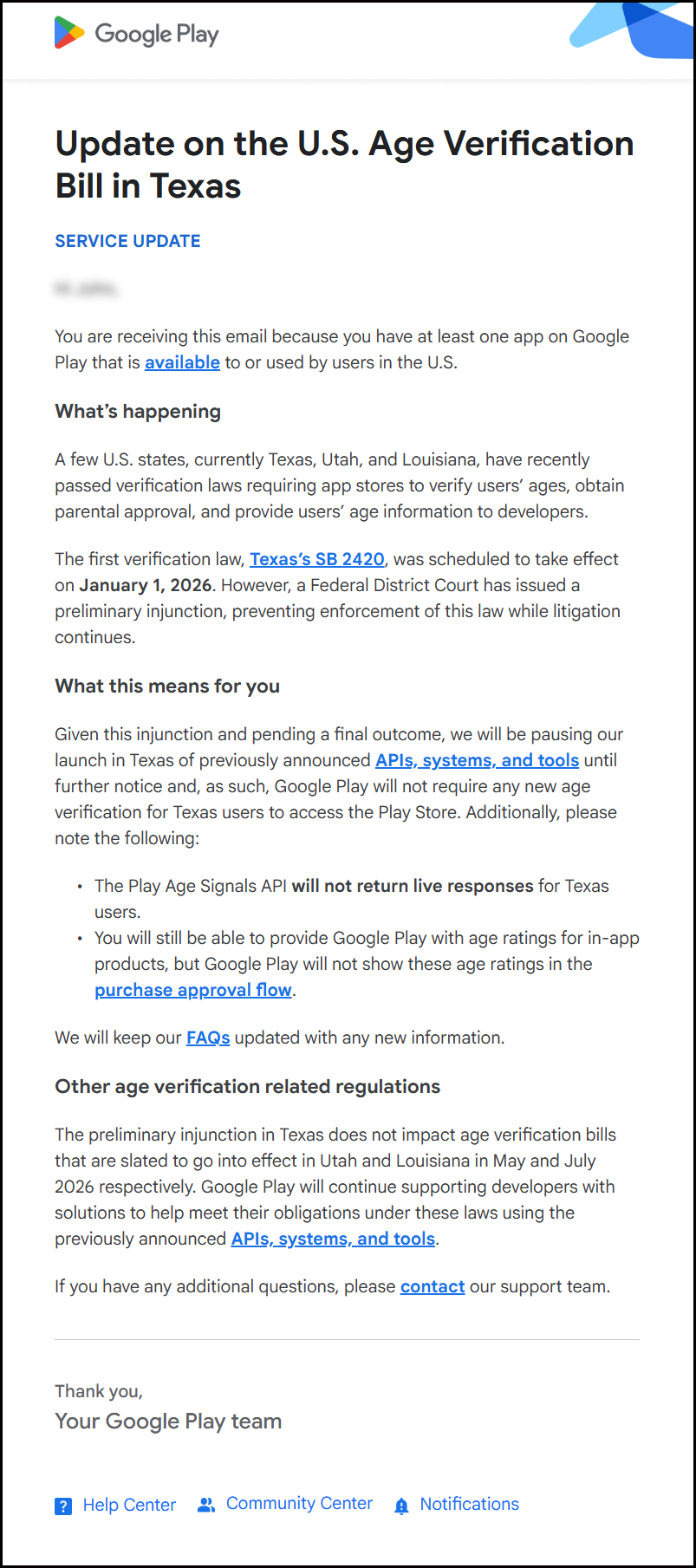
WEST PALM BEACH, FL – Today, Google sent developers an update about age verification laws in the United States. On its face, the message looked narrow and procedural – a paused rollout in Texas, upcoming compliance in Utah and Louisiana, and a reminder that Google Play would handle verification at the store level.
But beneath the legal footnotes and API references sits a much larger story – one that has little to do with age verification itself and everything to do with how major platforms respond when regulation threatens their control over users, monetization, and access.
This is not a developer inconvenience story. It is a platform strategy story.
The surface issue: state age-verification laws
Texas, Utah, and Louisiana have each passed laws requiring age verification, parental consent for minors, and the sharing of age information with app developers. Texas’s law was scheduled to take effect in January 2026, but a federal court has blocked enforcement while litigation continues.
In response, Google has paused its Texas rollout and confirmed that its “Play Age Signals” tools will not return live responses for Texas users – at least for now. Utah and Louisiana remain on track for mid-2026 enforcement, and Google says it will continue supporting developers with APIs and tooling.
On paper, this looks like a routine compliance update. In practice, it signals something much more consequential.
The real shift: app stores as the compliance layer
What Google is doing here follows a familiar pattern. Rather than forcing millions of developers to individually handle identity verification, parental consent, and regulatory exposure, Google is positioning Google Play as the compliance firewall between governments and the app ecosystem.
The pitch to developers is simple:
- You don’t collect IDs
- You don’t verify ages
- You don’t handle parental consent
- We’ll do it upstream
From a short-term perspective, that’s appealing. From a long-term perspective, it quietly re-centralizes control.
Age verification becomes:
- A store-controlled signal
- A proprietary input
- A dependency developers cannot replace or replicate
This is not about protecting developers. It is about protecting platform dominance under regulatory pressure.
Regulation as a lever, not a threat
When governments regulate platforms directly, platforms have two choices:
- Push responsibility downstream to developers
- Absorb the regulation and gain leverage
Google is choosing option two.
By becoming the identity and compliance broker, Google:
- Shields developers from legal risk
- Maintains a consistent ecosystem
- Prevents fragmentation
- Avoids app-level chaos
But it also:
- Increases switching costs
- Deepens dependency
- Expands its role beyond distribution into governance
This mirrors how Google has handled:
- Privacy controls in advertising
- Consent Mode
- Attribution changes
- Search algorithm compliance with regulators
Each time regulation tightens, the platform steps forward – not to relinquish power, but to reframe it as protection.
Why this matters to revenue, not just compliance
For subscription-based apps, SaaS tools, and freemium products, store-level age verification has real downstream effects – even if developers never touch a line of code.
When verification and approvals happen before an app loads:
- Conversion funnels are shaped upstream
- Purchase friction is no longer fully controllable
- Visibility can be gated based on signals developers do not own
This is especially important for:
- Social platforms
- Messaging apps
- Content communities
- Dating, gaming, and creator monetization tools
The store becomes not just the marketplace, but the first gate in the revenue funnel.
Apple is watching – and likely to follow
Although this email came from Google, the implications extend well beyond Android. Apple has tighter platform control, a stronger privacy narrative, and a long history of absorbing regulatory pressure at the App Store level rather than pushing it onto developers.
If courts allow these laws to stand, Apple will almost certainly respond with its own store-level verification framework – one that preserves Apple’s control while minimizing developer liability.
If courts strike these laws down, the platforms still benefit: they’ve tested the infrastructure, defined the narrative, and reinforced their position as indispensable intermediaries.
Either way, the platforms win optionality.
This is not about age – it’s about identity
Age verification is simply the entry point. Once app stores become normalized as identity and consent brokers, it becomes easier to justify:
- Expanded user classification
- Tighter access controls
- Greater influence over discovery and monetization
What begins as “compliance support” can evolve into platform-controlled identity signals that developers can’t audit, port, or replace.
That’s a strategic shift – not a legal footnote.
What developers should watch next
This is where the story becomes actionable.
- Whether age signals become mandatory rather than optional: Today, Google frames these APIs as support tools. Watch closely if they become prerequisites for certain categories, monetization models, or discovery placements.
- How purchase approval flows evolve: If age or parental approval increasingly sits between intent and transaction, developers may see conversion impacts they cannot directly diagnose or optimize.
- Whether identity signals expand beyond age: Age is a narrow signal. Broader classification – even if privacy-preserving – would materially change platform dynamics.
- Federal preemption versus state fragmentation: A single federal standard would entrench platform-level solutions. Ongoing state-by-state chaos would increase pressure to centralize further.
- How much visibility developers retain: The more signals platforms control upstream, the less insight developers have into why users see – or don’t see – their products.
The strategic takeaway
This moment is not about whether developers need to rebuild their apps. Most won’t. It’s about who controls access, identity, and monetization when regulation arrives. Google’s message makes one thing clear: the company would rather become the gatekeeper than let regulation fracture its ecosystem. Developers gain short-term protection, but at the cost of deeper dependency.
That tradeoff – safety in exchange for control – is becoming the defining pattern of the modern platform economy.

John Colascione is Chief Executive Officer of SEARCHEN NETWORKS®, a digital marketing and technology company founded in 2001. An entrepreneur, author, and digital publisher with more than 25 years of experience, he specializes in search engine marketing, Website Monetization, domain names, and online business development. He is the author of Mastering Your Website and publishes commentary on technology, digital marketing, and the evolving Internet economy. Read more at JohnColascione.com.
Add STRATEGIC REVENUE as a Google Preferred Source to see more of our business, technology, and digital strategy coverage in Google Search.
Add Strategic RevenueYou can now select the categories you're interested in and receive email updates when new articles are published in only those categories.