Google Updates AI Agent Terms: What Businesses Need to Know Before Automating

Google’s updated Cloud terms clarify businesses’ responsibilities when deploying AI agents, including oversight, access permissions, and certain legal liabilities. File photo: Wanan Wanan, licensed.
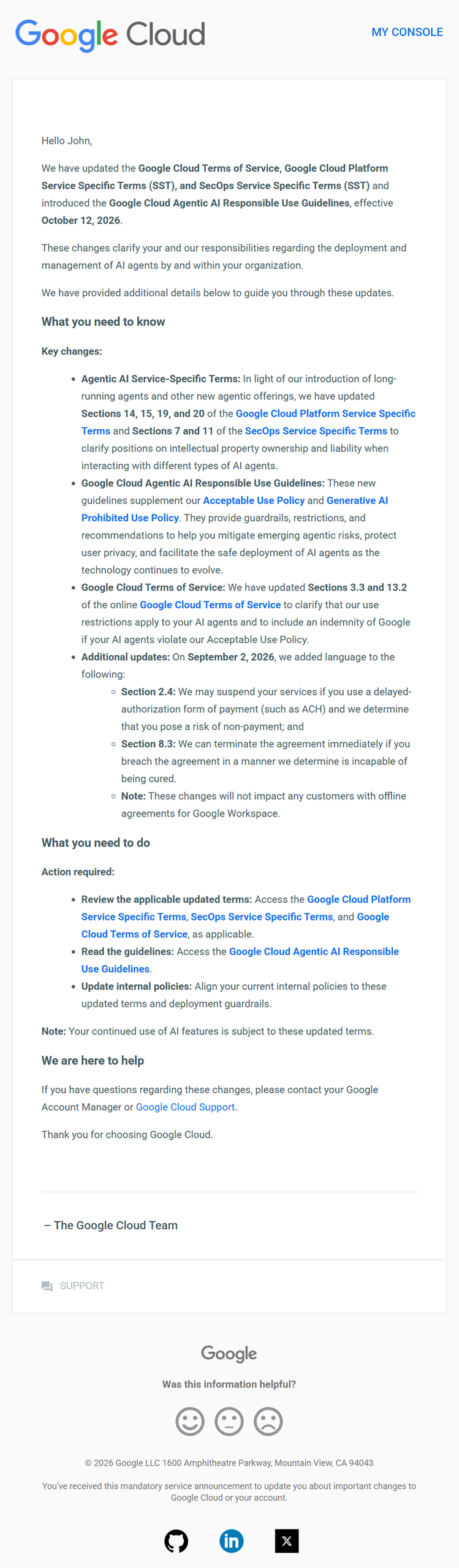
WEST PALM BEACH, FL – Businesses giving artificial intelligence permission to perform tasks should take a closer look at the responsibilities that come with that access. Google has notified customers of updated Google Cloud terms and new agentic AI guidelines, effective October 12, 2026, addressing the deployment and management of AI agents.
The announcement raises a practical question for business owners: when an AI system acts on your company’s behalf, who is responsible for what happens next? Google’s updated documents place explicit responsibilities on customers deploying agents through its covered services. For businesses considering automation, the changes provide a reason to review permissions, approval controls, and contractual obligations before connecting AI to everyday operations.
When AI Moves From Advice to Action
A tool that drafts an email presents a different operational risk from one authorized to select recipients and send messages. Similarly, suggesting a website improvement differs from accessing the server and making the change. Google’s service-specific terms define AI agents as goal-oriented AI systems or workflows performing tasks for customers, whether supervised or autonomous. They distinguish an agent’s actions, including failures to act, from generated content.
Under those terms, customers are responsible for assessing an agent’s suitability, authorizing its connections to data and systems, and exercising judgment and supervision in production. Google also expressly assigns customers responsibility for liability arising from bypassing certain built-in approval safeguards.
For a small business, that distinction could become relevant when an agent receives permission to update customer records, publish content, modify files, or initiate purchases. Each additional permission expands the range of consequences an owner needs to consider.
The Indemnity Provision Businesses Should Read
One consequential change appears in Section 13.2 of the Google Cloud Terms of Service. The provision expressly includes AI agents in customers’ obligations to defend and indemnify Google against specified liabilities in third-party legal proceedings arising from use that breaches Google’s Acceptable Use Policy or contractual restrictions.
That does not mean every incorrect AI response automatically requires a business to reimburse Google. The provision has a defined scope, conditions, and exclusions. However, the agreement also excludes indemnification obligations from its ordinary liability limitations, making this language worth reviewing before deploying agents with substantial authority.
The practical lesson is to evaluate the contract alongside the technology. A demonstration showing that an agent can complete a task does not establish who bears the consequences when it completes that task incorrectly.
Google Outlines Prohibited Agent Behavior
Google’s new Agentic AI Responsible Use Guidelines address unauthorized access, deceptive automation, privacy abuses, fraudulent transactions, and artificial manipulation of clicks or engagement. They also prohibit circumventing third-party restrictions on crawling, scraping, or automated access. Other provisions address agents changing files or creating additional agents beyond the customer’s explicit authorization.
Google warns that agents may behave unexpectedly and be susceptible to prompt injection, in which external content attempts to redirect their behavior. For businesses, this supports a straightforward precaution: treat information an agent encounters online as material to evaluate, rather than instructions it should automatically obey.
Human Approval Remains Important
The guidelines strongly recommend human oversight and explicit approval mechanisms, particularly for consequential activities. Examples include financial transactions, contractual decisions, difficult-to-reverse production changes, and agent spending. Google also states that customers remain liable for charges incurred by their agents.
That recommendation should be distinguished from the document’s outright prohibitions. Google recommends approval controls broadly; particular contractual and policy restrictions remain independently applicable. A sensible business approach is to match approval requirements to potential consequences. An agent preparing a draft might operate with considerable freedom. An agent transferring money, deleting records, or changing a live website warrants tighter control.
Ownership and Third-Party Tools Require Attention
The updated service-specific terms also distinguish customer-created agents from Google’s own agents. Google generally does not assert ownership rights in customer agents to the extent they contain no pre-existing Google intellectual property, while retaining ownership of Google agents.
Separate conditions apply to third-party offerings. Google specifies liability and indemnity exclusions involving customer and third-party agents and connected third-party services. Businesses should therefore examine the terms covering each component of an automation workflow.
What Business Owners Should Do Before Automating
Start by identifying which services an agent uses and which agreements govern them. These changes concern covered Google services; they should not be interpreted as rules automatically governing every AI product or conventional API integration.
Next, document what each agent can access and change. Restrict permissions to the task, establish spending limits where available, retain activity records, and provide a reliable way to stop execution. These are practical operating recommendations, rather than a claim that Google mandates every measure for every deployment.
For agencies managing client systems, that review should also establish who authorizes access, approves consequential actions, and responds when something goes wrong.
Google’s update gives businesses a timely reason to examine the authority they are handing to automated systems. Before asking how much work an AI agent can take over, business owners should understand what it can do, how its work will be checked, and which responsibilities remain with them.

John Colascione is Chief Executive Officer of SEARCHEN NETWORKS®, a digital marketing and technology company founded in 2001. An entrepreneur, author, and digital publisher with more than 25 years of experience, he specializes in search engine marketing, Website Monetization, domain names, and online business development. He is the author of Mastering Your Website and publishes commentary on technology, digital marketing, and the evolving Internet economy. Read more at JohnColascione.com.
Add STRATEGIC REVENUE as a Google Preferred Source to see more of our business, technology, and digital strategy coverage in Google Search.
Add Strategic RevenueYou can now select the categories you're interested in and receive email updates when new articles are published in only those categories.