
Google’s New Ad Policy Puts Domain Names Back in the Trust Conversation

WEST PALM BEACH, FL – Google’s latest advertising policy update may not have been intended for the domain industry, but domain investors and brand owners should probably pay attention.
In a June 12, 2026 notice sent to advertisers, Google announced updates to its Limited Ad Serving Policy that will gradually roll out through 2028. The policy is designed to reduce negative advertising experiences by placing greater emphasis on advertiser identity, transparency, and user trust. Although the rollout is scheduled over the next two years, I expect that elements of the policy are already being used to alter impression rates.
While much of the discussion will likely focus on advertising compliance and advertiser qualification, one recommendation buried near the end of Google’s notice stands out for anyone who follows domain names. Google suggested that some advertisers may benefit from pinning their domain name to the front of their ad headline.
That may sound like a minor technical recommendation, but it touches on a much larger issue: trust.
Google’s Concern Is Identity Confusion
The policy update repeatedly references situations where users may become confused about who they are actually doing business with. According to Google, advertisements that reference other brands or advertisements with little or no branding may create uncertainty about the advertiser’s identity. In some situations, Google says this confusion could contribute to limited ad impressions on certain searches.
The company explained:
“We also want to ensure that the identity of the advertiser the user chooses to engage with is unambiguous.”
That statement is perhaps the most important sentence in the entire policy update. Google is not merely evaluating keywords, bids, and landing pages. It is increasingly evaluating whether users clearly understand who is behind an advertisement.
Why the Domain Name Matters
For many businesses, the domain name is the brand.
A user who sees:
- Insurance.com
- Cars.com
- Hotels.com
or a well-established company domain immediately gains context about who is advertising and what the business does.
By comparison, advertisements built around generic marketing language without clear branding may leave users guessing.
Google’s recommendation was specific:
“Clearly identify your brand by pinning your domain.”
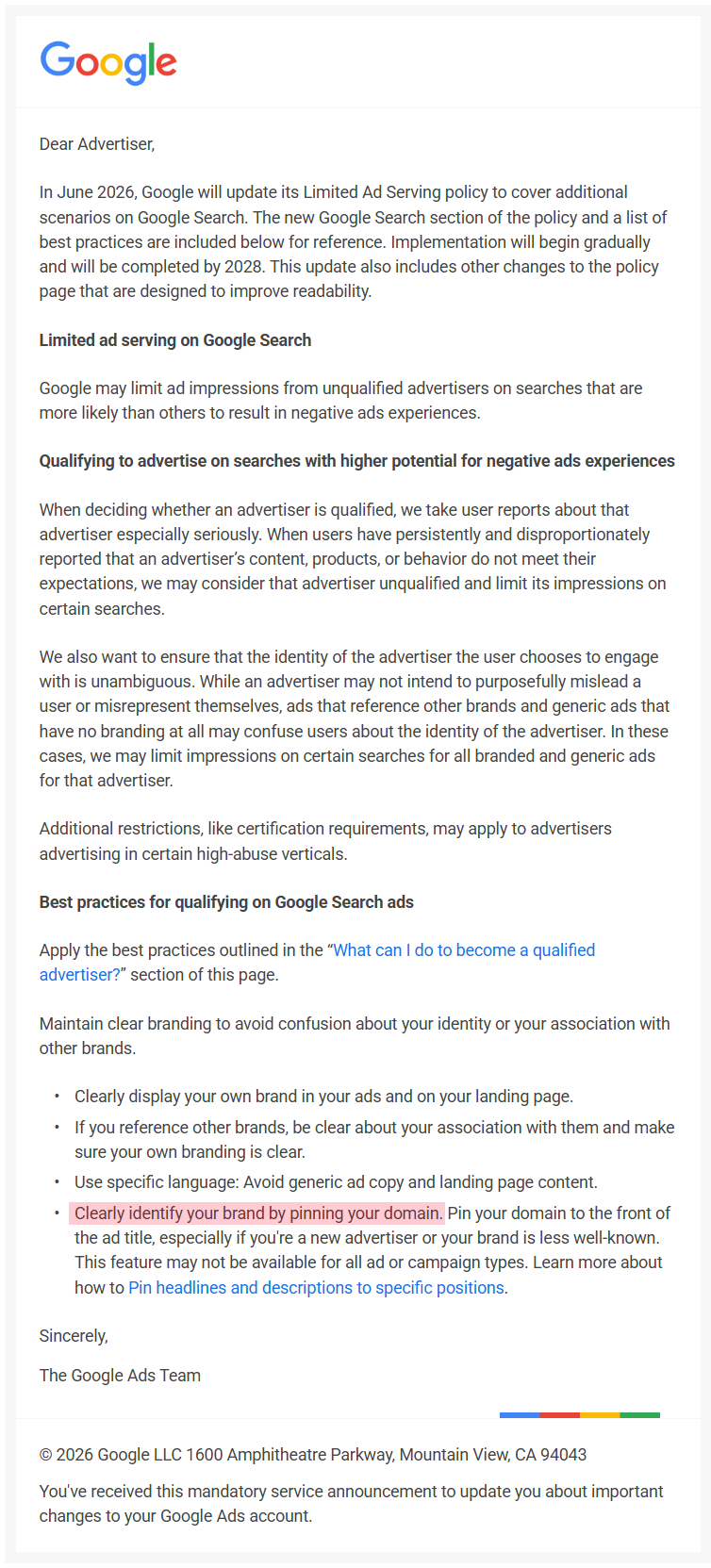
Importantly, Google did not instruct all advertisers to do this.
The recommendation appears primarily directed at advertisers whose identity may not be immediately obvious, particularly newer advertisers or businesses with less-recognized brands. Still, the guidance is noteworthy because it places the domain name directly into the discussion about trust and transparency.
A Shift Away From Generic Advertising
For years, many advertisers focused on broad marketing claims and keyword-heavy headlines designed to maximize click-through rates.
Examples include:
- Best Insurance Rates
- Top SEO Company
- Affordable Legal Services
- Compare Mortgage Offers
While these headlines may generate clicks, they do not necessarily tell users who is behind the advertisement. Google now appears more concerned with making sure users understand exactly which company they are engaging with before they click. That represents a subtle but meaningful shift.
Domain Names as Trust Signals
The domain industry has long argued that premium domain names offer benefits beyond direct navigation traffic.
A strong domain can:
- Establish credibility
- Improve brand recognition
- Reduce confusion
- Reinforce legitimacy
- Create consistency between advertising and the landing page
Google’s latest policy update does not suddenly make premium domains more valuable overnight. However, it does acknowledge something domain investors have argued for decades: users pay attention to names. When Google advises advertisers to make their identity unmistakable, domain names naturally become part of that conversation.
The Big Picture
This policy update arrives at a time when Google is investing heavily in advertiser verification, business verification, entity recognition, and AI-powered search experiences. Across Google’s ecosystem, there is a clear trend toward understanding who is behind a website, advertisement, or business listing.
The June 2026 policy update should be viewed through that broader lens. Google is not telling every advertiser to pin their domain name. What Google is saying is that advertiser identity matters, user trust matters, and confusion about who is advertising can become a problem.
For domain owners, that is an interesting development. The industry has spent years arguing that domain names are more than technical addresses. Google’s latest guidance may be another sign that recognizable names and clear branding are becoming increasingly important in an internet economy built on trust.

About The Author: John Colascione is Chief Executive Officer of SEARCHEN NETWORKS®. He specializes in Website Monetization, is a Google AdWords Certified Professional, authored a how-to book called ”Mastering Your Website‘, and is a key player in several online businesses.
Add STRATEGIC REVENUE as a Google Preferred Source to see more of our business, technology, and digital strategy coverage in Google Search.
Add Strategic RevenueYou can now select the categories you're interested in and receive email updates when new articles are published in only those categories.



Good news, thank you.